

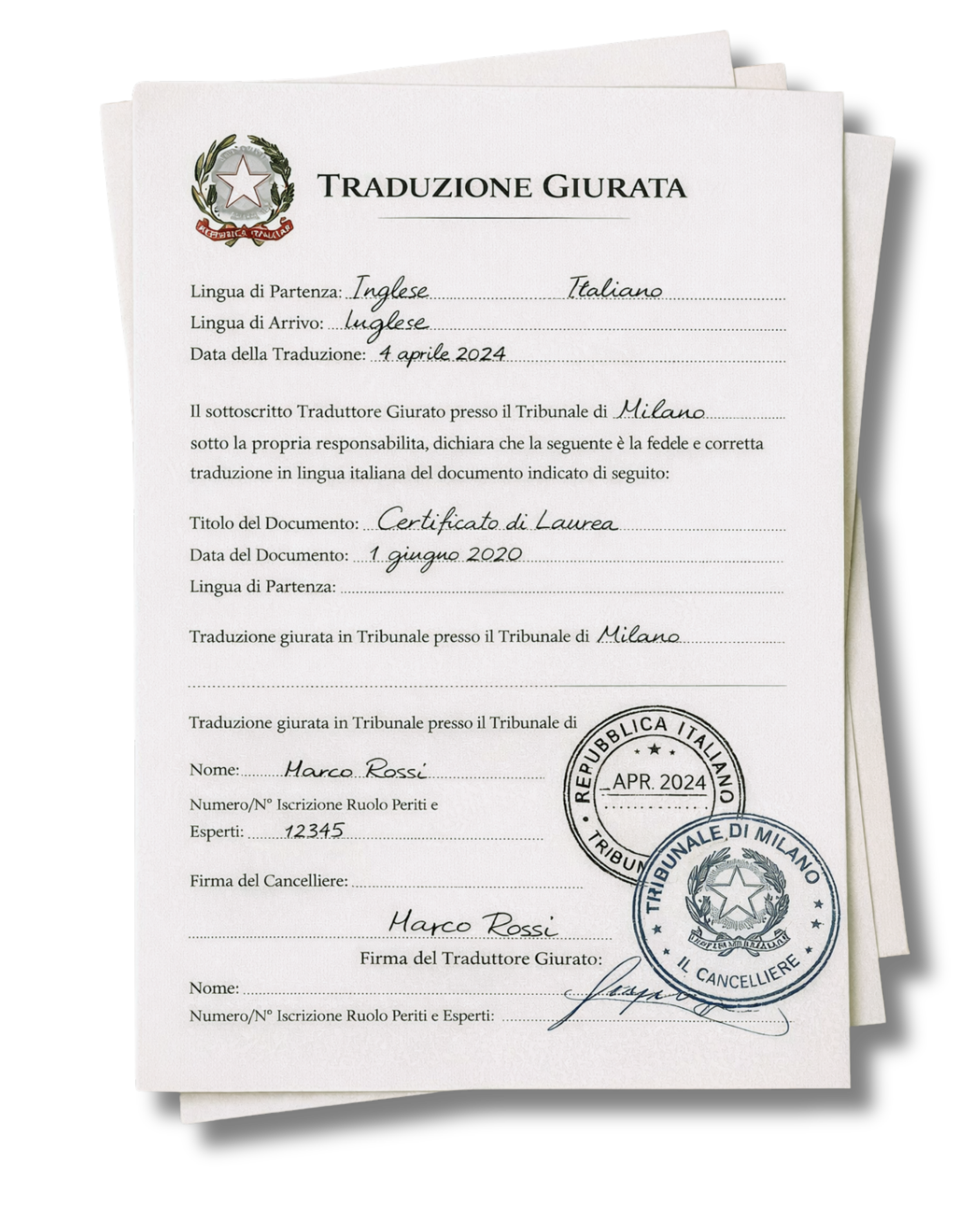
Official Sworn Italian Translations (Traduzione Giurata) Certified at the Local Italian Court
Certified Court-Ready Translations for Italian Dual Citizenship, Legal Filings, Consulates Submission

Your Solution For Italian Dual Citizenship
At Philadelphia Notary & Apostille, we have helped dozens of clients in Philadelphia and across the United States successfully navigate the complex process of apostilles and sworn translations for use in Italy. Whether you are applying for dual citizenship, residency, marriage registration, university enrollment, or legal proceedings, our firm ensures your documents meet Italian government requirements from the very beginning. We assist with apostilled birth certificates, marriage certificates, court records, FBI background checks, academic diplomas, and powers of attorney & NARA certificates requiring official Italian sworn translation.
Unlike many translation providers who simply translate documents and leave clients to manage the Italian court process themselves, we coordinate the full procedure. In Italy, sworn translations often require the original apostilled documents to be presented before the court, revenue stamps (marca da bollo) applied, and the translation formally attested in person by a court-appointed translator. Our network of Italian sworn translators handles these formalities directly, ensuring your translations are properly sworn and legally valid before Italian courts and government authorities.
In addition, our firm specializes in apostille services and online notarization in all 50 states, making us a comprehensive solution for clients preparing documents for Italy. We work closely with you — and, when necessary, your Italian attorney or comune — to confirm every requirement is satisfied before submission. Our goal is to prevent delays, eliminate guesswork, and provide a streamlined, compliant process for sworn translations and apostilles for Italy from Philadelphia to Rome.

Our Step By Step Process
Collect & Prepare Your Documents
Because every case is unique, we work from the direction provided by you or your attorney to make sure your documents are correctly prepared for apostille and sworn translation.
Notarize & Apostille (All 50 States)
We notarize (if required) and obtain apostilles from the correct Secretary of State or federal authority to ensure full international validity.Sworn Translation & Court Attestation in Italy
Once apostilled, we scan and transmit your documents to our Italian sworn translators. Our team handles the sworn translation, revenue stamps (marca da bollo), court appointments, and official attestation in Italy.Final Verification & Digital Copies
After completion, we scan the finalized sworn translations and provide you with digital copies for your records.Overnight Return Shipping or Local Pickup
Your fully completed documents are securely shipped overnight back to you, or you may pick them up directly at our Philadelphia office.
Most Common Documents We Translate
-
Birth Certificates
Required for dual citizenship, residency applications, marriage registration, and civil status recognition in Italy. These must often be apostilled and sworn translated for submission to Italian courts or comuni.
Marriage Certificates
Used for registering a marriage in Italy, citizenship applications, or updating civil status records. Italian authorities require precise sworn translations that match the original format.
Death Certificates
Needed for inheritance matters, probate proceedings, or updating civil registries in Italy. Accuracy is critical for legal recognition.
Divorce Decrees
Required to update marital status records in Italy or to remarry. These court-issued documents must be properly apostilled and sworn translated for legal validity.
Court Judgments
Includes custody orders, adoption rulings, and other legal determinations. Italian courts require official sworn translations to recognize foreign judicial decisions.
Certificates of Non-Existence (No Record Letters)
Often required for citizenship applications when a birth or marriage record cannot be located. These official letters must be apostilled and sworn translated.
NARA Letters (National Archives Records)
Used in Italian citizenship cases when federal naturalization records are involved. These government-issued documents must be translated precisely to meet Italian court standards.
Naturalization Certificates
Critical for jure sanguinis (Italian dual citizenship) applications to establish lineage and citizenship status. Italian authorities require exact sworn translations of these records.
USCIS Documents
Includes immigration records, petitions, and status confirmations. These documents often support citizenship and residency applications in Italy.
Name Change Documents
Court-ordered name change records are required to reconcile discrepancies across civil documents for Italian citizenship or legal registration purposes.
-
Power of Attorney (Procura)
Allows a legal representative in Italy to act on your behalf for citizenship filings, property transactions, or court matters. These documents must be formally translated and sworn for use before Italian authorities.
Affidavits
Sworn statements used to clarify discrepancies in names, dates, or civil status. Italian courts often require these to be notarized, apostilled, and translated.
Identity Documents
Includes passports, driver’s licenses, and state-issued IDs. Translations are often required for residency, marriage registration, or legal filings.
Academic Diplomas & Transcripts
Used for university enrollment, professional licensing, or credential recognition in Italy. These often require apostille and sworn translation.FBI Background Checks
Frequently required for residency permits or long-term visa applications in Italy. Must be federally apostilled and sworn translated.
Frequently Asked Questions
-
Pricing depends on several factors, including the number of documents, total page count, word count, required turnaround time, Italian court fees, revenue stamps, and the level of formatting and review required. Italian sworn translations must be presented in a specific court-approved format, and each document must comply with strict procedural requirements. For this reason, we provide customized quotes after reviewing your documents and instructions.
-
A certified translation is typically completed by a professional translator who provides a signed certificate of accuracy. In the United States, certified translations are commonly used for USCIS and other domestic purposes and may sometimes be accompanied by an apostille. However, many local governments and courts in Italy may not accept certified translations alone.
A sworn translation, on the other hand, requires the physical apostilled documents to be presented before an Italian court. The translator takes an oath before the court attesting to the accuracy of the translation, and each document is subject to official court procedures and revenue stamps (marca da bollo). This process gives the translation full legal validity in Italy.
-
Italian courts, comuni, and government authorities often require sworn translations to ensure legal recognition of foreign documents. For matters such as dual citizenship, court filings, civil registration, Declaration of Value (DoV) or legal proceedings, a sworn translation guarantees that the document has been formally attested before an Italian court and meets local legal standards.
-
Turnaround times vary depending on court appointment availability in Italy, the number of documents, total page and word count, and formatting complexity. Once we review your documents, we will provide an estimated completion timeline. Expedited timelines may depend on court scheduling and procedural requirements.
-
Yes. Sworn translations are formatted to closely mirror the structure and layout of the original document whenever possible. This includes maintaining headings, seals, stamps, signatures, dates, and overall document organization so the translation corresponds clearly to the source document.
Italian courts require translations to accurately reflect the original content and presentation. While the translation must comply with Italian court formatting standards, every effort is made to ensure it aligns as closely as possible to the original document for clarity and official review.
-
All documents shipped to Italy are sent with tracking and are scanned before processing begins. However, we strongly recommend that every client retain additional certified copies of all documents prior to submission. While we take every precaution, maintaining backup copies ensures protection in the rare event of shipping issues.
-
Philadelphia Notary & Apostille is a true one-stop solution for documents destined for Italy. Unlike agencies that only translate — or firms that only handle apostilles — we manage the entire process from notarization and apostille in all 50 states to sworn translation, Italian court attestation, revenue stamps, and secure return shipping. This eliminates the need for multiple vendors and reduces the risk of costly mistakes.
Our team understands how apostilles and sworn translations work together. We coordinate each step according to your instructions or your attorney’s guidance to ensure your documents are properly prepared before they reach the Italian court. From initial review to final delivery, we streamline the process so you avoid delays, confusion, and unnecessary back-and-forth.
For clients in Philadelphia and nationwide, we provide a structured, professional process with clear communication and full document tracking — giving you confidence that your documents are handled correctly from start to finish.
-
No. Philadelphia Notary & Apostille is not an Italian immigration law firm, and we do not provide legal advice. We specialize in document preparation services, including notarization, apostilles, and coordinating sworn translations for use in Italy.
Each citizenship, residency, or legal matter is unique. We process documents based on the guidance and instructions provided by you or your attorney to ensure they are properly prepared for apostille and sworn translation. If legal interpretation or eligibility advice is required, we recommend consulting a qualified Italian immigration attorney.
-
Yes, we offer flexible payment options and payment plans. We accept all major forms of payment, including debit cards, credit cards, ACH transfers, bank transfers, checks, and deposits. For larger projects, structured payment plans may be arranged.
A minimum of 50% is always required upfront before processing begins, with the remaining balance due prior to final delivery. We do not charge any additional credit or debit card processing fees — we cover those costs so there are no surprise charges.